Technology & Combat Characteristics
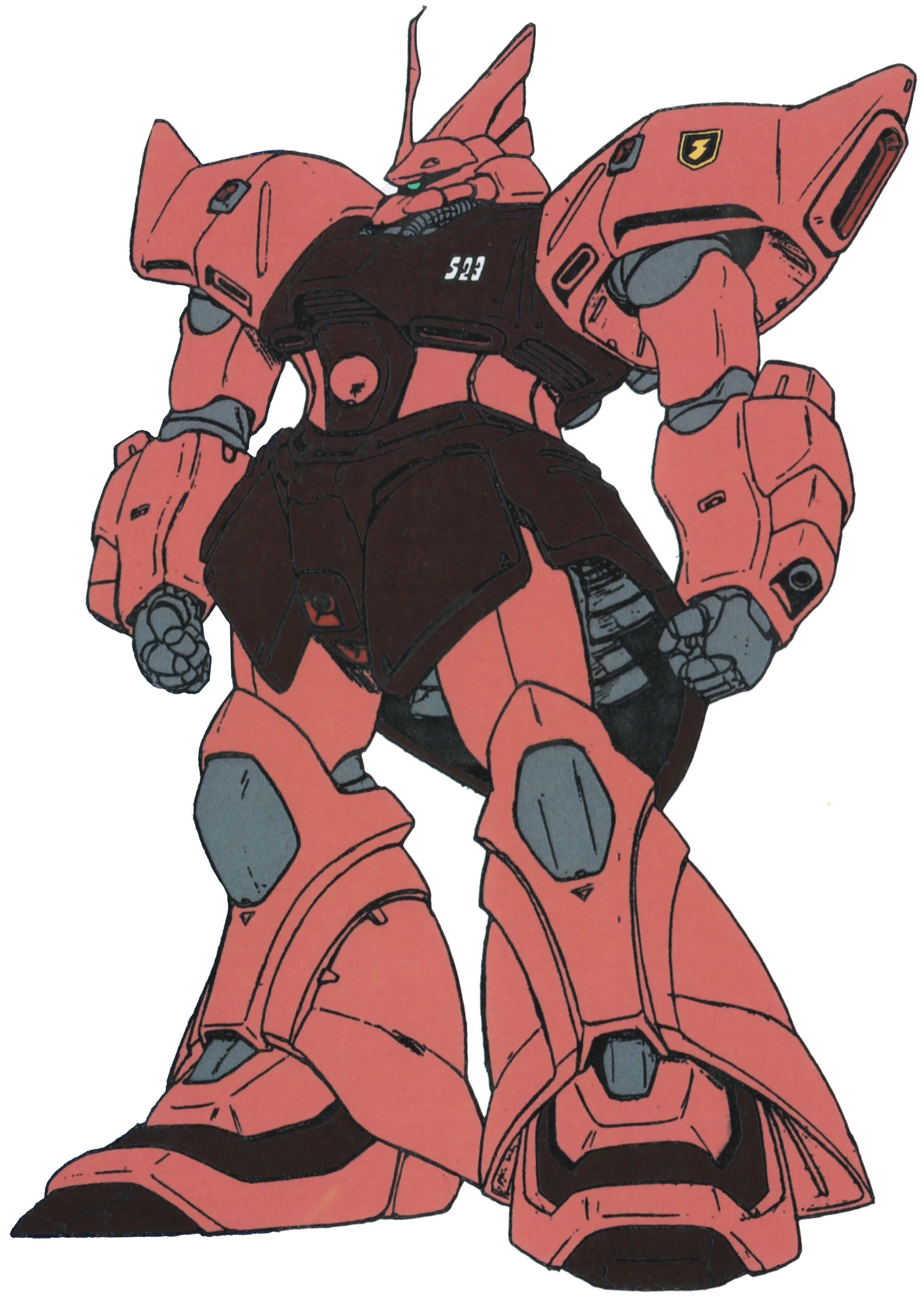
A variation of the MS-14 Gelgoog, the MS-14JG was specialized for precision firing mission, and was also known as "Gelgoog Sniper Type". It was designed with the United Maintenance Plan (UMP) in mind, greatly increasing its specifications and ease of piloting, as well as simplifying its manufacturing process and improving the interchangeability of its parts with other models.
The Gelgoog Jäger was equipped with a total of 24 posture control sub-thrusters in addition to the main thrusters, significantly improving its mobility in space. Due to its nature as a sniper unit, its monoeye has a larger field of vision than standard units. In addition, since it was designed as a commander unit, it was equipped with a head-mounted blade antenna by default for enhanced communications. Similarly, its backpack had another antenna and a laser communication unit.
The Gelgoog Jäger's primary weapon was a large-sized beam machine gun, which could either fire pulsed beam pellets or a single-shot long-range beam. It was able to use this weapon thanks to a tuned up, new model generator. The beam machine gun's low rate of beam deterioration, combined with its exceptionally accurate scope and the Jäger's latest fire control hardware and software, granted it unparalleled firing accuracy.
As with other UMP mobile suits, the Gelgoog Jäger adopted standard 2nd Phase Production Type cockpit and manipulators, meaning it had the same control scheme as its peers and could use all of their weapons, reducing the required pilot training time for switching models and compensating for Zeon's lack of pilots.
History
Developed at the very end of the One Year War, the Gelgoog Jäger was produced only in very limited numbers. as the first phase of Operation Rubicon, three warships from the Zeon Mobile Assault Force: the high speed cruiser Graf Zeppelin and the light cruisers Siegfried and Valkyrie, launched their mobile suit teams at the Side 6 colony of Ribo.
The mobile suit teams, which consisted of numerous MS-09R-2 Rick Dom II, MS-06FZ Zaku II Kai, and at least three Gelgoog Jäger, soon engaged in combat with the RGM-79GS GM Command Space Type defending the colony. The Gelgoog Jäger fared well against the GM Command Space Time, shooting down at least two. Unbeknownst to the Earth Federation Forces, the attack was a diversion. Taking advantage of the chaotic battle, Zeon soldier Bernard Wiseman entered the colony in a special duty vessel disguised as the civilian cargo ship Agua Verde.
Gelgoog Jägers also appeared as simulated enemies in the RX-78NT-1 Gundam NT-1's combat simulation program.
In December, U.C. 0082, a group of three Zeon Remnant pilots – Sergeant Major Francy Berdeau, Sergeant Tug, and "The Professor" – launched several terrorist attacks on the outskirts of Von Braun using a modified YMS-16M Xamel cannon and three customized mobile suits.
Berdeau, piloting the MS-06F Zaku II (Gunner), balanced the Xamel cannon; The Professor, piloting the MS-06F-2 Zaku II (Rangefinder), collected targeting data; finally, Tug, piloting a restored Gelgoog Jäger, aimed the Xamel cannon based on data from the Zaku II Rangefinder. The Gelgoog Jäger was selected for this role due to having been designed for long-range sniping.
After the trio launched an attack on Anaheim Electronics' Livermore Plant on December 4, AE ordered test pilot Jack Bayard to assit with EFF lunar patrols in the experimental RX-78GP00 Gundam "Blossom". In an astronomical coincidence, when the trio fired the Xamel cannon, the shell ended up hitting the GP00's radome, revealing their location.
Tug, piloting the Gelgoog Jäger, attempted to attack the GP00 using its Spike Shield, but ended up missing. Eventually, after a chaotic scuffle, all three Zeon Remnant pilots were arrested by a GM Command Space Type accompanying the GP00.