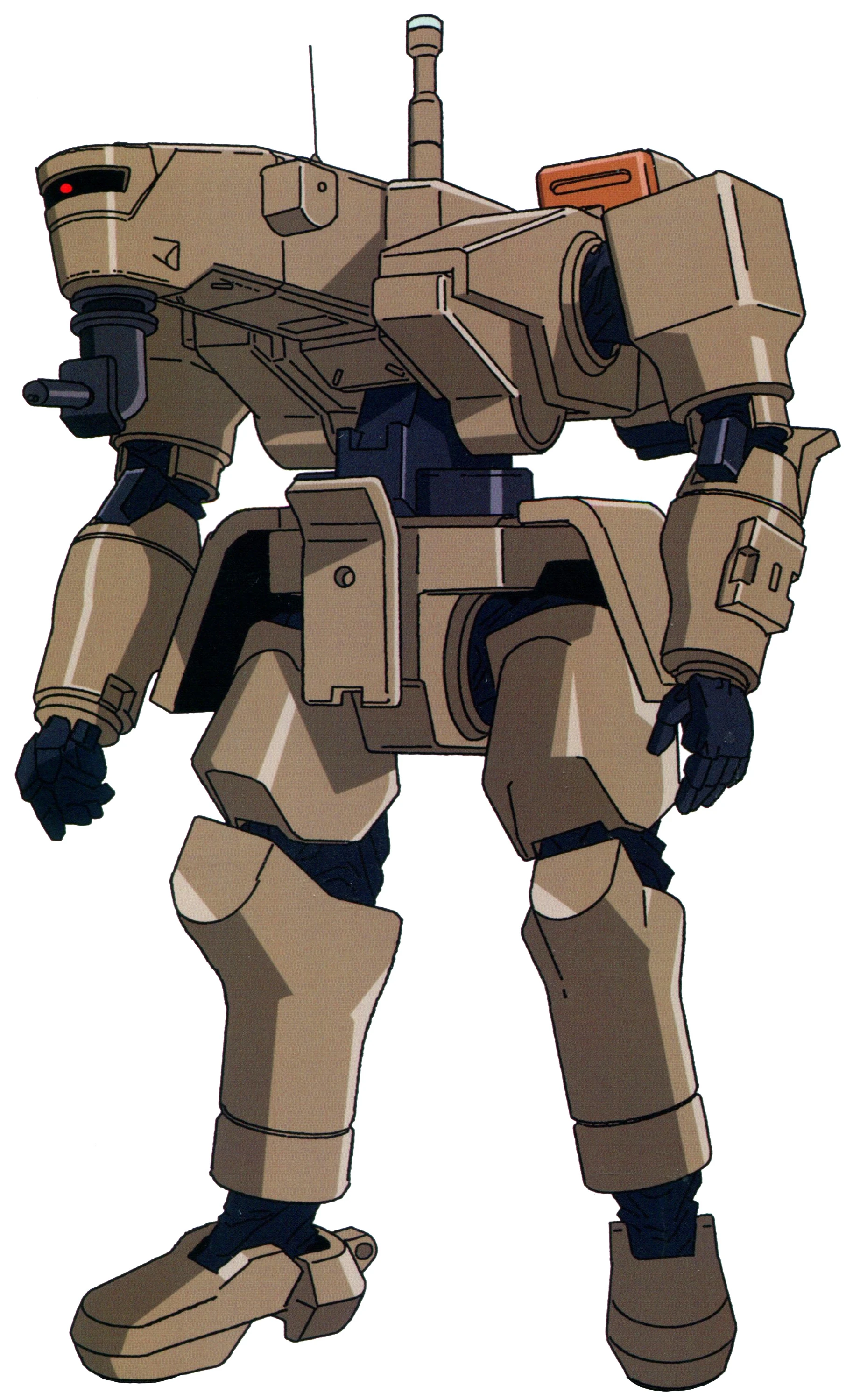
Technology & Combat Characteristics
As indicated by its model number, the MSER-04 Anf, is a redesigned version of the Human Reform League's (HRL) retired mainstay mobile suit, the MSJ-04 Fanton, for export and rental purposes. The Fanton is being replaced by the MSJ-06II-A Tieren Ground Type as the HRL turned away from fossil fuel in favor of solar energy. Differences between the Anf and the Fanton are minor, consisting of some altered armor and a new set of weaponry. Running on fossil fuel like its predecessor, the intended clients for the Anf are naturally centered on the fossil fuel using Middle Eastern nations. This is reinforced by its name, Anf, which means "Nose" in Arabic.
Export of the Anf later expands from the Middle East to the entire African continent. As a mobile suit, the Anf has exceptional low price, making it very suitable for the many poor nations in these regions as well as terrorist groups in various locations that could not afford newer mobile suits. There are also simply no better alternatives for them. Other characteristics that make the Anf popular include its low breakdown rate and a structure that can be easily repaired. The success of the Anf in the Middle East prompted the HRL to produce more, further reducing its manufacturing cost and leading to increase demand from other regions.
As fossil fuels are hard to obtain outside of the Middle East, a chemical reaction fuel engine that does not emit carbon dioxide was developed by HRL as a substitute for fossil fuel engine. Many early production Anfs have made the switch to this new engine, as the retrofitting process is relatively simple. The Anf's cockpit has a cramped interior, but this lack of comfort is not a major issue, as combat operations typically do not last very long. The pilot controls the mobile suit while leaning forward awkwardly to look at the monitor located in a relatively small, rectangular, protruding viewing port.
To maintain minimal level of combat capability while keeping costs down, the Anf's standard armament is a head-mounted machine and a forearm-mounted smoothbore gun. Its combat performance is inferior to the Tieren Ground Type and other new mobile suits, but it remains formidable against other types of weapons. In nations where Anfs are the mainstay mobile suits, their opponents are also using Anfs, so they end up countering each other. The Anfs are also used in non-combat roles such as for work purposes, maintaining public order, etc. Even in AD2312, with the GN Drive-related technology driving rapid advancement in the field of mobile suit, the Anf is still very common globally thanks to its value for money and high reliability.
History
As the Human Reform League (HRL) phased out the Fanton for the Tieren series, it redesigned the old mobile suit into the Anf for export and rental. With its fossil fuel engine, the Anf is targeted at Middle Eastern nations that have access to this rare resource and have not benefited from the Solar Power System. From there, the export of Anf expands to Africa. In both regions, the Anf reign as the mainstay mobile suit. This extremely cheap mobile suit is so common in the Middle East that it is joked that any missile fired in the region will definitely hit an Anf.
One of the Middle Eastern nations using Anf is the Kingdom of Azadistan, which is known to have deploy the mobile suit in AD 2301 during the war against the Republic of Krugis. When a civil war occurred in Azadistan in AD 2307, a coup d'état group unsuccessfully attempted to use Anfs to destroy the solar power receiving station being built by the United Nations. Anfs were also seen guarding the nation's royal palace. Terrorist groups also make use of this mobile suit, with one such group attempting to attack a nuclear facility in the Taklamakan Desert. Unbeknownst to them, this terrorist group was used by the three blocs (HRL, Union and AEU) to lure Celestial Being into a trap.
Numerous trading companies worldwide are also involved in the selling of Anfs. Some of them supplied work-use Anfs (units without any weaponry) to regions under arms embargo and then offer local services to modify these units into combat use mobile suits. It is an open secret that regions under arms embargo have numerous combat use Anfs. There are also unscrupulous companies that merely polish the exterior of retired Fantons and put them on sale as newly produced Anfs.
The HRL does deploy Anfs locally but they are mostly modified Fantons. The northern HRL regions that see few mobile suit battles have more Anfs than the south, where the operating mobile suits are being replaced by the Tieren series at a higher rate. The Anfs were also utilized by the Sinhalese majority during the civil war in Ceylon, where they go up against the Tieren series machines of the HRL-backed Tamil Tigers.
In Union's territories, the overall number of Anfs is very low. In Alaska and other parts of North America, some Anfs are used by the armed forces for tests. Anfs with certain functions restricted are also imported for personal use and use by private companies. In South America, the number of Anfs is higher as older mobile suits operating there before the region joined the Union are still in use. In Australia, Anfs are mostly imported for work related purposes. They are operated as large Work Loaders as their durability and power output are superior to their Union made counterparts. A small number of combat use Anfs is stationed in Australia for emergency deployment in Southeast Asian countries to protect the Union's Orbital Elevator.
In the AEU, the Anf's deployment state is similar to that of Australia. The overall number of Anfs here is low, with more than half deployed for work related purposes. The combat use Anfs are mainly deployed in regions that are close to Moscow and other HRL territories.
Even in AD 2312, there are still more Anfs worldwide than the Earth Sphere Federation Forces' GN-X series, with the bulk of these cheap mobile suits being found in HRL. It is also one of the many mobile suits operated by the anti-federation group, Katharon, and is painted in the group's distinctive blue color scheme.