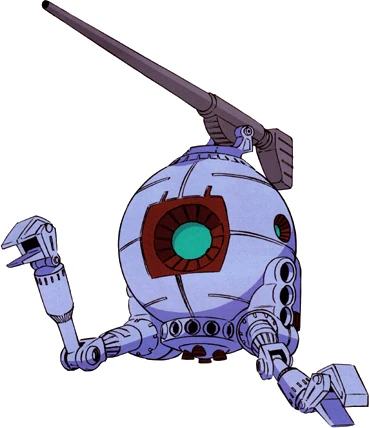
Technology & Combat Characteristics
During the One Year War, the Earth Federation initially refitted about 1200 civilian-use SP-W03 Space Pods for military-use, thus creating the first RB-79 Balls. These Balls were reinforced with heavier armor and equipped with a 180mm low-recoil cannon on top and multiple thrusters on the body. Unlike the liquid-fueled directional thrusters on mobile suits, the Ball's thrusters utilized "directed" solid fuel explosives, with each detonation creating an impulse that could change the direction of the Ball. This gave the Ball good reaction speed and reasonable maneuverability from each thrust, but comparatively very limited use of the system.
The Ball had an advantage when it came to refueling on board Columbus-class ships due to the lack of beam weapons and low number of fuel thrusters, making the refueling/rearming time extremely short compared to the larger and more complex mobile suits. In fact, the thrusters and weapons were designed to be modular, allowing depleted thruster banks and empty gun magazines to be removed by the servicing crew to be reloaded at a later time, and fully-loaded ones to be quickly installed in their place. Because the Ball does not have a thermonuclear reactor and is driven by a fuel cell, it could be operated even on ships without MS cooling facilities.
At first, the Ball was seen as ill-suited for combat, even earning the nickname "Mobile Coffin" among EFSF pilots. It had limited ammo, relatively thin armor (though sloped to assist in projectile deflection), and lacked the AMBAC system or any close combat weapon. However, some statistics counter this view of the Ball being weak – in fact, its specifications were superior to many of its opponents. The Ball was smaller than a RGM-79 GM, making it a more difficult target to hit, and also giving it a higher acceleration rate than most contemporary mobile suits and mobile armors, including the MS-06 Zaku II, MS-09R Rick Dom, and even the RX-78-2 Gundam. Together with having a greater sensor range than the Zaku, these factors made the Ball well-suited for hit-and-run tactics even when not supporting GMs.
The Ball's greatest advantage, however, came from its low cost, with a single Ball costing about 1/4 of a GM. This enabled it to be heavily mass-produced, leading to Balls being widely used as support units for warships and GMs during the war. A standard EFSF combat team consisted of 3 GMs and 2 Balls to counter Zeon's 3-MS tactical units, although other formations existed. Ball-only teams consisting of 2 RB-79 Balls and 1 RB-79K Ball Type K have been seen launching from Salamis-class cruisers, as well as various large formations launching from Columbus-class ships.
History
The concept for a combat mobile pod was devised as early as U.C. 0076 under the RX-76 project. However, development was put on hold until February 13, U.C. 0079, when the project was revived with renewed interest.
At the onset of the One Year War, the Earth Federation did not take the mobile suit threat seriously – this was until the Principality of Zeon military completely outmaneuvered and decimated the Earth Federation Space Force with their MS-06 Zaku II. In response to this, the Federation scrambled to create their own mobile weapons that could counter the Zeon attack. However, their new prototype mobile suit, the RX-78-2 Gundam, and their first mass-production mobile suit, the RGM-79 GM, were not being fielded fast enough. Thus, the RB-79 Ball was born, being rolled out starting in June of U.C. 0079. Easier to build and mass produce, the Ball was soon on the front lines fighting Zeon mobile suits.
One of the most crucial battles involving Balls was Operation Star-One, an operation undertaken to further pressure Zeon into retreating from Earth after the Federation took the upper hand following Odessa. Since the GM was not yet ready, over 1000 Balls were committed along with numerous Salamis-class and Magellan-class warships. Their numbers overwhelmed the Zeon fleets and drove them away, however countless Balls were destroyed in one of the most brutal battles for the Federation. Soon afterwards, the Ball earned the nickname "Mobile Coffin" among EFSF pilots.
Despite its poor reputation, the Ball was able to provide fire support and hold the line until the GMs entered the War. Following the introduction of the GM, Balls would continue to be used in combat mainly as support units, and would participate in large numbers in the Battles of Solomon and A Baoa Qu.