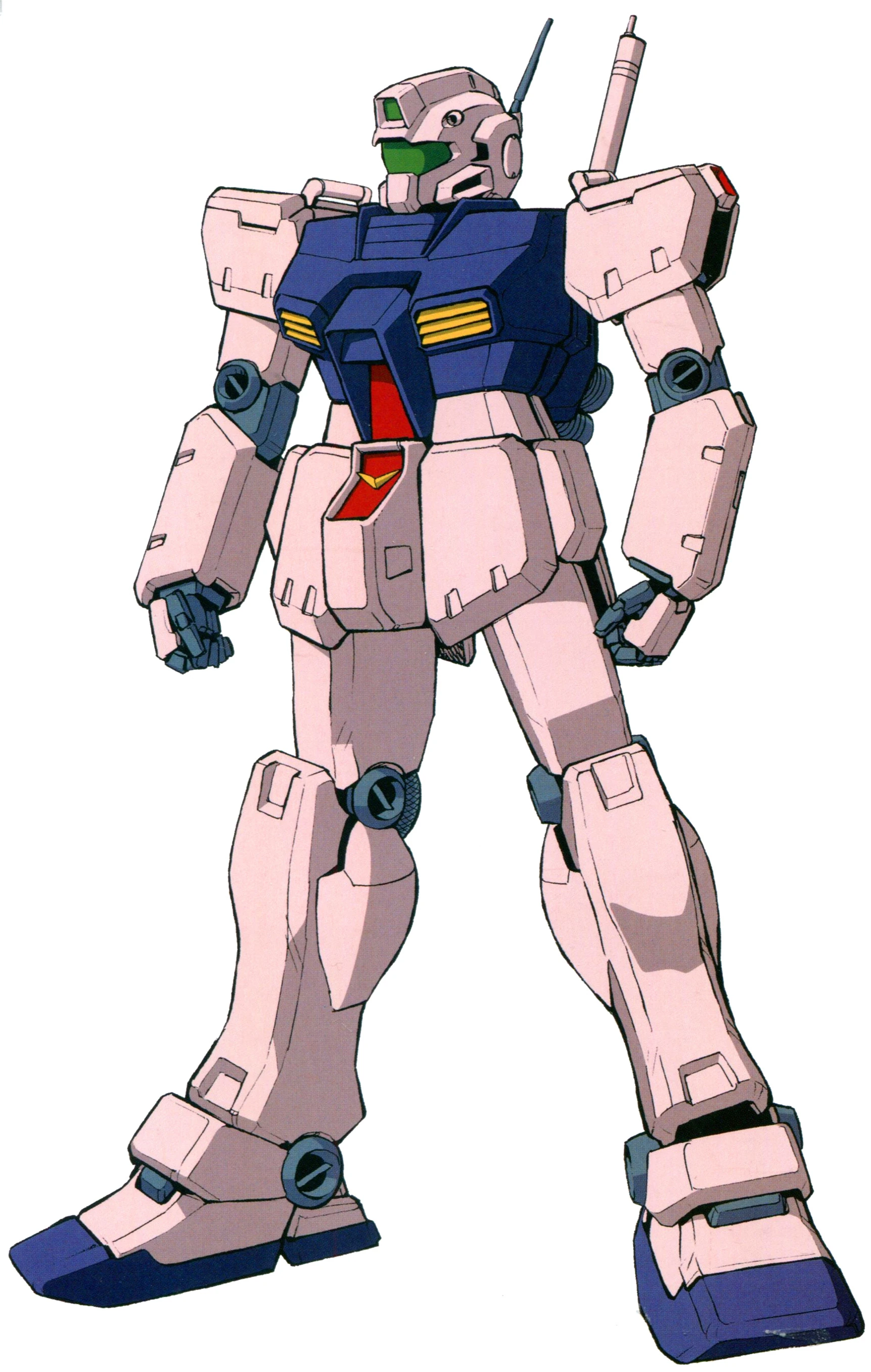
Technology & Combat Characteristics
A late production variant of the RGM-79 GM, the RGM-79C GM Type C featured improved output and numerous other modifications, while also incorporating newly developed technology, with the aim of achieving the objectives set by Operation V. It was intended to serve as a reference template for the GM series, which had a number of wildly different designs and specifications due to being produced during wartime. The GM Type C prioritized productivity throughout its development process and became a highly stable and reliable unit.
The Type C's head unit, while mostly following the basic structure of the standard GM, also incorporated mechanisms from the D Type and the G Type. Various devices and sensors have been replaced with components that were easier to produce, contributing to improved productivity. Some secondary co-processor frames and monitoring equipment, as well as various subsystems, were simplified. The head vulcan guns, which were highly effective as close-range weaponry, received an increase in ammunition capacity. Finally, to enable easy modification based on operational needs, the arrangement of various terminals was improved, making customization and tuning easier to implement.
The cockpit design of the RGM-79C was almost the same as that of the RGM-79, but the seating structure and the arrangement of various control systems were improved for better comfort and operability. The cockpit block of the RGM-79 was structurally designed with reference to the Core Block of the RX-78 Gundam. This structure was also adopted in the RGM-79C, allowing the mobile suit to be specialized toward space or ground use by simply replacing the central block. However, when the RGM-79C was in production, there were very few instances of deployed units having their central block replaced. It seems that it was done only in very rare cases, such as pilot or unit reassignments, or when constructing refitted or experimental machines. Finally, due to changes to the specifications of the generator and electrical systems, the central blocks of the RGM-79 and the RGM-79C were not interchangeable without special modifications.
The arm structure of the RGM-79C was very simple, adopting a standard design that prioritized high productivity and reliability. The side panels on the arms were designed for easy installation and replacement of optional equipment. This arm design was based on the one used by the "Augusta series" of mobile suits, which boasted the best overall efficiency and achieved equivalent specifications in a smaller volume compared to those designs used by other mobile suits. This arm structure was considered to have great potential for fundamentally improving the "movability" of the mobile suit, as well as the practical advantage of having fewer parts and thus lower attrition rate, which contributed to its adoption.
The leg structure of the RGM-79C adopted a simple frame design covered by standard armor, eliminating any extraneous equipment.
After the One Year War, the Federation faced the challenge of appropriately deploying ground forces. As such, this structure, which was based on a standardized version of the existing GM series legs, was adopted in favor of the leg structure of the RX-78NT-1 Gundam NT-1, which would have been costly and challenging to tune. Another goal was enhancing functionality by turning the legs into large vernier units, leading to the design of a configuration with exposed high-capacity energy supply cables and the ability to add various devices. This provided great convenience in terms of adding leg thrusters, evaluating material performance, and conducting component matching tests, potentially allowing the GM Type C to achieve a level of adaptability similar to Zeon's MS-06 Zaku II. In this sense, the GM Type C was a very versatile MS that could have taken on various roles.
History
The GM Type C entered mass production near the end of the One Year War. It was designed to be the reference template for the GM series, since the design and specification of GM variants produced during the war were heavily inconsistent.
During the Battle of A Baoa Qu on December 31, a large number of RGM-79C (then named "GM Late Type") participated in the attack on A Baoa Qu's E Field. Following the end of the war, production of the GM Type C continued as part of the Federation Forces Reconstruction Plan, a plan to replace destroyed weapons and update obsolete ones at each Federation stronghold. In April, U.C. 0081, around ten units were assigned to Torrington Base, several of which were modified to become testbed units.
Despite a large production number, the GM Type C never entered combat as a true main force mobile suit. This was due to its lackluster performance during the Delaz Conflict in U.C. 0083, during which it failed to combat the outdated mobile suits employed by the Delaz Fleet. It should be noted, however, that most of these units were caught off guard by Delaz Fleet's surprise attacks. During the attack on Torrington Base, for example, many units were destroyed before having a chance to fight back.
Regardless, it served as the reference for Federation mobile suits in the 80s onward, and made great contribution to the establishment of development know-how. Various GM Type C-based testbed units and data collection units, such as the RGM-79 Powered GM, became the foundation for future Federation mobile suits.
Several GM Type Cs also appeared in the seventh and eighth chapters of the Anaheim Laboratory Log series. These machines were owned by Anaheim Electronics for non-combat use and were painted in AEUG colors. Some were also modified to be commander units and they have legs with spare propellant tanks and thrusters attached, similar to those of the RGC-83 GM Cannon II's. Anaheim used its GM Type Cs in support roles during operational tests of the FXA-08R-X1 Proto Mega Rider.